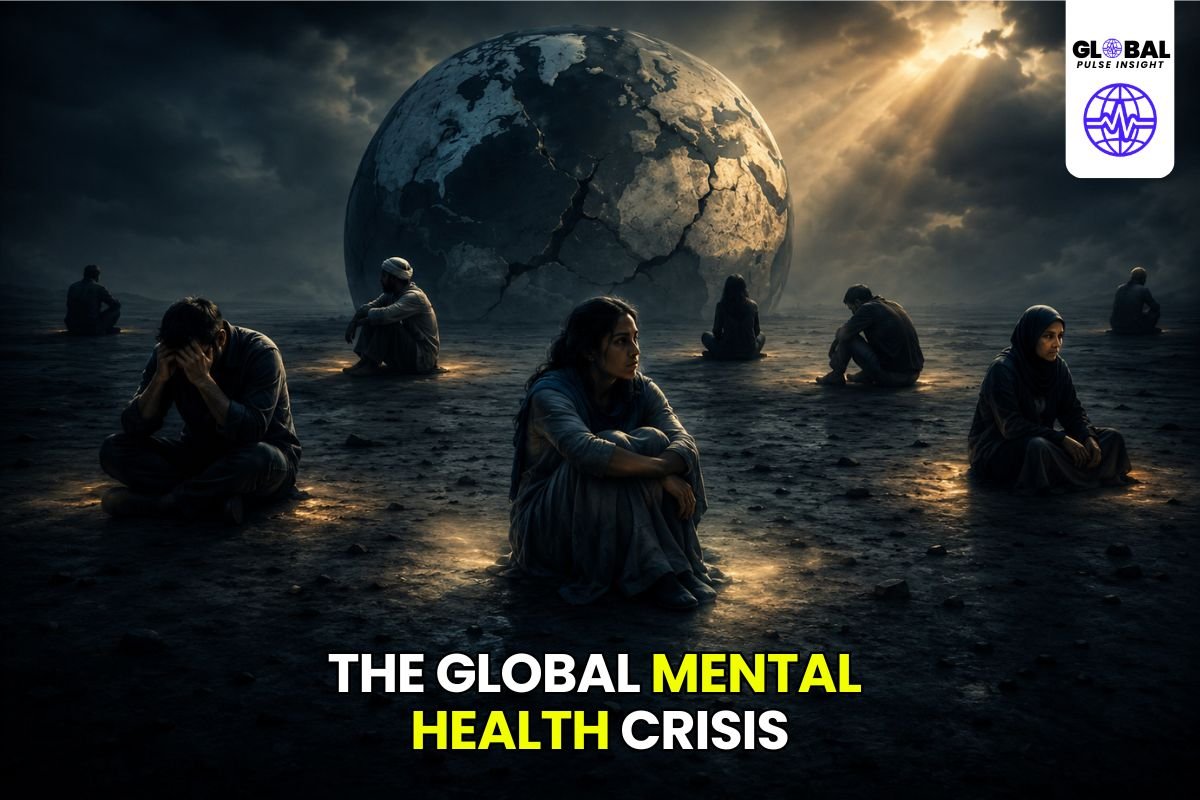
There is a mental health crisis unfolding right now that does not make front pages the way wars or natural disasters do. It has no dramatic footage, no sudden moment of collapse. It builds slowly, quietly, inside the minds of ordinary people – a student in Jakarta who cannot get out of bed, a factory worker in Lagos who has not slept properly in months, a mother in Mexico City who describes a darkness she cannot explain to anyone around her.
Mental illness has become one of the defining public health emergencies of our time. And yet, across most of the world, it remains profoundly underfunded, poorly understood, and surrounded by a silence that costs lives every single day.
The Scale of the Problem Is Staggering
Let us start with the numbers, because they demand to be taken seriously.
Nearly 970 million people worldwide are living with a mental health or substance use disorder. That is roughly one in every eight people on the planet. Depression affects 280 million people worldwide, making it one of the leading causes of disability globally, while anxiety disorders affect 301 million people – he largest single mental health diagnostic category. globalpulseinsight
These are not mild cases of stress or occasional sadness. Clinical depression and generalized anxiety disorder cause severe functional impairment – affecting a person’s ability to work, maintain relationships, and in the most serious cases, their will to continue living.
Suicide claimed an estimated 727,000 lives in a single recent year, and among young people aged 15 to 29, it ranks as the third leading cause of death. That figure alone should be enough to demand urgent global attention. Somehow, it rarely does. globalpulseinsight
Why This Crisis Is Getting Worse, Not Better
The Pandemic’s Lasting Shadow
The COVID-19 pandemic did not create the mental health crisis. But it accelerated it dramatically, and the effects are still being felt years later.
WHO data shows that the pandemic increased rates of anxiety and depression by approximately 25% globally in 2020, adding approximately 76 million new cases of anxiety disorder and 53 million new cases of major depressive disorder. Women and young people were disproportionately affected. globalpulseinsight
What made this worse was the timing. The pandemic disrupted mental health services in 93% of countries, creating a catastrophic mismatch between rising need and reduced supply. Precisely when more people needed help, the systems meant to provide that help were overwhelmed, shut down, or redirected toward managing the physical health emergency. globalpulseinsight
Healthcare workers bore a particularly heavy burden. Burnout, anxiety, and depression surged among doctors, nurses, and frontline staff – many of whom are still struggling today.
The Youth Mental Health Emergency
If one aspect of this crisis deserves to be called an emergency within an emergency, it is what is happening to young people.
Approximately 10% of adolescents globally experience a mental disorder, and 70% of all mental disorders begin by the age of 18. The implications of that second statistic are profound. Most adult mental illness has its roots in childhood and adolescence – meaning that failing to identify and treat young people early creates a lifetime of suffering and a generation of adults who never received the help they needed during the years when intervention would have mattered most. globalpulseinsight
Among college students, more than 25% have been diagnosed or treated for a mental illness, and 64% of students with mental health conditions have stopped pursuing their education because of those conditions. These are not marginal figures. They represent a generation whose potential is being systematically undermined by a crisis that remains under-resourced and under-discussed. globalpulseinsight
Social media’s role in this picture is complex and contested. Research consistently links heavy use of platforms like Instagram, TikTok, and X with higher rates of anxiety, depression, and poor self-image among teenagers – particularly girls. Yet the technology companies behind these platforms have been slow to implement meaningful protections, and governments have struggled to regulate an industry that moves faster than legislation can follow.
The Treatment Gap: A Global Failure
Perhaps the most damning aspect of the global mental health crisis is not its scale, but the gulf between how many people need help and how many actually receive it.
Despite the staggering prevalence of mental illness worldwide, only 50.6% of adults with mental health issues received treatment. That means roughly half of all people living with a diagnosable mental disorder are going without care. In low and middle-income countries, the situation is far more extreme. globalpulseinsight
Global mental health funding sits at approximately $3 per person per year. Three dollars. For context, that is less than the cost of a cup of coffee in most major cities. The global median of government health expenditure directed toward mental health is less than 2%. globalpulseinsightglobalpulseinsight
This is not a resource problem in the sense that wealthy countries lack the means to do better. It is a prioritization problem. Mental health has historically been treated as a secondary concern – something dealt with after the more visible, more politically legible crises of physical illness, poverty, and conflict. The result is a chronic underfunding that has persisted for decades.
Only 30% of countries have a national mental health plan. The remaining 70% are managing – or failing to manage – one of the most prevalent health conditions on the planet without any coordinated national strategy. globalpulseinsight
The Economic Cost Nobody Is Counting Properly
There is a tendency in policy discussions to frame mental health as a compassionate issue – important, but somehow separate from the hard calculations of economic productivity and national competitiveness. This framing is not just wrong. It is expensive.
Depression and anxiety alone cost the global economy an estimated $1 trillion annually in lost productivity. When you factor in the broader costs – absenteeism, reduced performance at work, higher rates of physical illness among people with untreated mental disorders, the economic burden on families and caregivers – the true figure is far higher. globalpulseinsight
The total annual economic cost of mental health conditions globally is estimated at $6 trillion. To put that number in perspective, it exceeds the GDP of every country on earth except the United States and China. And that cost is projected to grow significantly over the coming decade as populations age, inequality deepens, and the social conditions that generate psychological distress become more pronounced. globalpulseinsight
The business case for investing in mental health is overwhelming. Studies consistently show that every dollar invested in treatment for depression and anxiety returns approximately four dollars in improved health and productivity. Yet governments continue to allocate a fraction of what would be required to close the treatment gap.
Regional Disparities: Not All Suffering Is Equal
The global mental health crisis is not evenly distributed, and understanding where the gaps are deepest matters for any serious response.
Sub-Saharan Africa has the highest prevalence of depression among WHO regions at 5.7%, while suicide results in approximately 700,000 deaths annually, with 80% of those deaths occurring in low and middle-income countries. globalpulseinsight
This geographic concentration of the worst outcomes in the world’s poorest regions reflects a brutal reality: mental health systems are often entirely absent in communities where need is greatest. In many parts of Sub-Saharan Africa, South Asia, and rural Latin America, there are virtually no trained mental health professionals available. Communities rely on traditional healers, religious institutions, or – most commonly – nothing at all.
In low-income countries, treatment gaps for schizophrenia exceed 89%. People living with severe mental illness in these regions frequently receive no treatment whatsoever for their entire lives. globalpulseinsight
Even in wealthy countries, access to mental health care is far from universal. Long waiting lists, high costs, and a persistent shortage of trained therapists and psychiatrists mean that mental illness frequently goes untreated even where systems theoretically exist to address it.
Is Technology Part of the Solution?
One of the more hopeful developments in recent years has been the emergence of digital mental health tools – apps, platforms, and AI-powered services that aim to extend access to psychological support beyond the traditional clinic.
Leading platforms include Calm, Headspace, BetterHelp, Talkspace, and Woebot – an AI-powered cognitive behavioral therapy chatbot. Growing evidence from randomized controlled trials suggests that app-based CBT produces clinically meaningful reductions in depression and anxiety symptoms, with effect sizes comparable to face-to-face therapy for mild to moderate presentations. globalpulseinsight
This is genuinely encouraging. But digital tools are not a substitute for human care, and they are not reaching the communities with the greatest unmet need. Access to smartphones, reliable internet, and the literacy required to navigate mental health apps remains deeply unequal. Technology can extend the reach of mental health care – but only if accompanied by sustained investment in the human infrastructure needed to support it.
FAQs
Q1. How many people worldwide are affected by mental health disorders in 2026?
Nearly 970 million people globally live with a mental health or substance use disorder, according to current estimates. That represents approximately one in every eight people on earth.
Q2. What are the most common mental health disorders globally?
Anxiety disorders are the most prevalent, affecting 301 million people worldwide. Depression is the second most common, affecting 280 million people, and is one of the leading causes of disability globally.
Q3. Why do so many people with mental illness go untreated?
The reasons are multiple: stigma, lack of trained professionals, inadequate funding, geographical barriers, and cost. In low-income countries, treatment gaps exceed 80% for most mental health conditions. Globally, mental health receives less than 2% of most government health budgets.
Q4. How does mental illness affect the global economy?
Depression and anxiety alone cost the global economy $1 trillion annually in lost productivity. The broader economic cost of all mental health conditions is estimated at $6 trillion per year – a figure that continues to grow.
Q5. What can be done to address the global mental health crisis?
Experts consistently point to three priorities: dramatically increased government funding for mental health services, integration of mental health care into primary healthcare systems so it reaches communities without specialist facilities, and sustained efforts to reduce the stigma that prevents people from seeking help.
Conclusion
The global mental health crisis is not a niche concern or a problem confined to wealthy countries with the luxury of worrying about psychological wellbeing. It is a universal human emergency that touches every nation, every community, and very likely every family on earth.
Almost a billion people are living with conditions that cause real, measurable suffering – and the majority of them are doing so without any meaningful support. The economic arguments for action are as compelling as the moral ones. The tools to begin closing the treatment gap exist. What has been missing, consistently and across generations, is the political will to treat mental health as the urgent global priority it plainly is.
That has to change. The scale of this crisis demands nothing less.