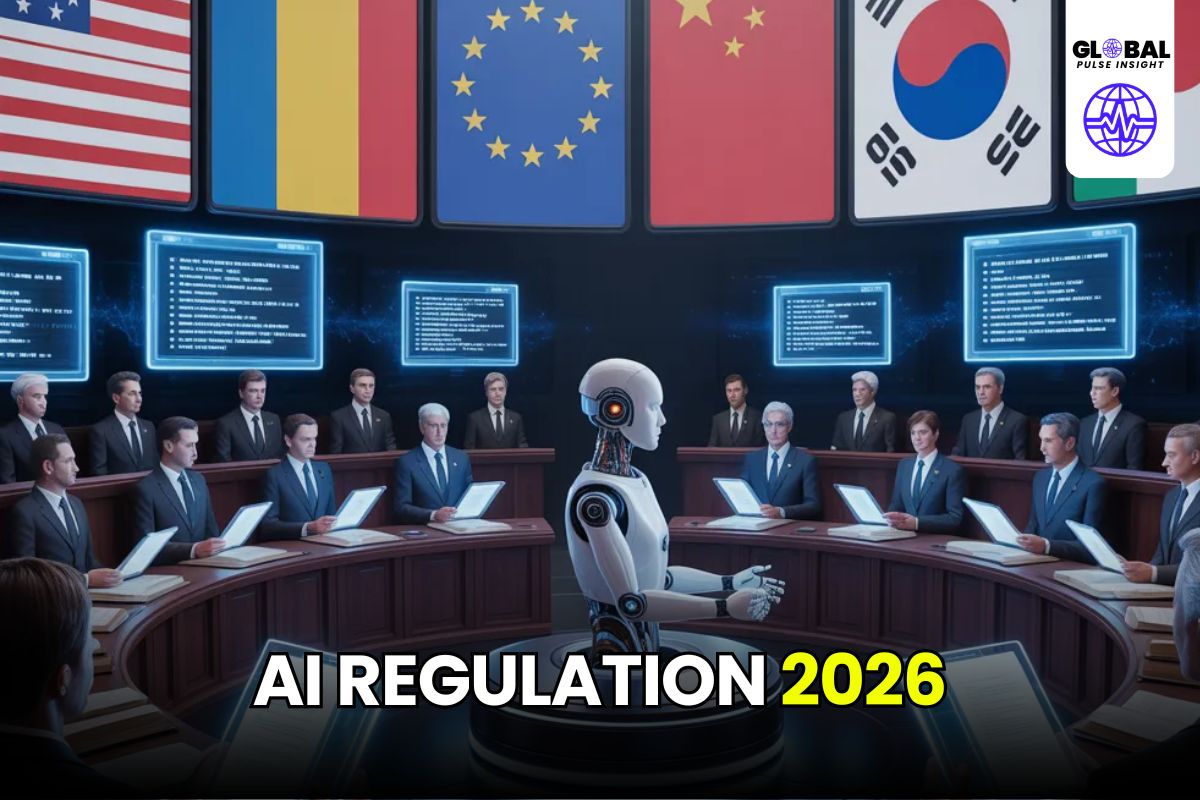
There is a quiet race happening right now – not for rockets or oil, but for something far more consequential. Governments around the world are scrambling to write the rules for artificial intelligence before AI writes the rules for them.
It sounds dramatic. But when you consider that AI systems are already deciding who gets a job interview, who qualifies for a bank loan, and how criminal sentences are calculated, the urgency becomes very real. In 2026, the global debate over AI regulation 2026 has moved well past academic papers and conference panels. Laws are being passed, fines are being issued, and the decisions being made in Brussels, Washington, Beijing, and Seoul today will shape the digital world for decades.
Why AI Regulation Has Become Urgent
For most of the last decade, governments largely left artificial intelligence alone. The technology was moving fast, the economic potential seemed enormous, and nobody wanted to be the country that slowed innovation with red tape.
That hands-off approach has become increasingly difficult to defend. AI-generated deepfakes have flooded social media. Algorithmic hiring tools have been found to discriminate against women and minorities. Autonomous systems have made errors with life-altering consequences. And the raw processing power behind modern AI models has grown so dramatically that even their creators admit they do not fully understand what these systems are capable of.
Over 75 countries are now actively developing or tracking AI legislation – and the pressure is intensifying. This is no longer a theoretical policy debate. It is a live, urgent, and genuinely consequential conversation happening in parliaments, courtrooms, and corporate boardrooms simultaneously. globalpulseinsight
The European Union: Setting the Global Standard
When historians look back at this moment, the European Union’s AI Act may well be remembered as the most ambitious regulatory intervention in the history of technology.
The AI Act entered into force on 1 August 2024, and will be fully applicable two years later on 2 August 2026, with some exceptions. The law takes a risk-based approach – meaning not all AI is treated equally. Systems that pose minimal risk, like spam filters or basic recommendation engines, face few restrictions. But AI used in employment decisions, credit scoring, law enforcement, or healthcare is classified as high-risk and subject to strict rules around transparency, documentation, and human oversight. globalpulseinsight
In Q1 2026 alone, EU member states issued 50 fines totalling €250 million, primarily for non-compliance – with Ireland, home to most major tech company EU headquarters, handling 60% of those cases. globalpulseinsight
The enforcement is real. The consequences are financial. And multinational companies are paying attention.
There is, however, a significant complication. The European Commission published a proposal in November 2025 to defer the high-risk compliance deadline from 2 August 2026 to 2 December 2027. The reason is pragmatic: many EU member states have not yet appointed the national regulators responsible for enforcement, and the technical standards companies need to demonstrate compliance are not yet finalized. A second trilogue between EU institutions in April 2026 ended without agreement on the deferral, leaving companies in genuine uncertainty about which deadline actually applies. globalpulseinsight
For businesses operating across Europe, the message is clear: prepare now, regardless of the final timeline.
The United States: A Patchwork in Progress
America’s approach to AI regulation looks nothing like Europe’s. There is no federal AI law. There is no single regulatory body. What exists instead is a rapidly expanding patchwork of state-level legislation that is creating serious compliance headaches for companies operating nationally.
Colorado became the first U.S. state to pass a comprehensive AI law – the Colorado AI Act – which requires AI developers and deployers of high-risk AI systems to exercise reasonable care to prevent algorithmic discrimination and mandates clear disclosures to consumers when interacting with AI systems. The law has been amended to delay implementation to June 2026. globalpulseinsight
On March 30, 2026, California Governor Gavin Newsom issued an executive order directing state agencies to draft recommendations for AI safety requirements – including on illegal content, bias, and civil rights – for companies doing business with state agencies. In New York, Governor Hochul signed amendments shifting the RAISE Act toward a transparency and reporting-based framework. globalpulseinsight
At the federal level, the White House has released a legislative framework signaling a push for national standards – with a notable goal of preventing state laws from conflicting with any future federal standard. But actual federal legislation remains elusive. A comprehensive AI bill is not expected before the second half of 2026 at the earliest, and political dynamics in Washington make its passage far from guaranteed.
The result is a genuinely fragmented landscape. A company using AI-powered hiring tools must navigate different rules in Colorado, California, New York, and Texas – with more states adding their own requirements every few months.
China: Tight Control, Clear Rules
China’s approach is fundamentally different from both Europe and the United States. Rather than debating how much freedom to give AI, Beijing has moved quickly to establish firm, enforceable controls – particularly around content generation and data.
China enforces multiple AI regulations, including the Generative AI Services Management Measures and synthetic content identification rules, which became effective September 1, 2025. These laws impose obligations around consent, data quality, content labeling, user rights, and complaint handling. globalpulseinsight
In practice, this means that any AI-generated image, video, or audio produced in China must be clearly labeled as synthetic. Deepfakes are tightly restricted. AI services that generate content on political topics face the most stringent oversight.
China’s model prioritizes state control and social stability over innovation freedom. Critics argue this limits creativity and suppresses dissent. Supporters contend it reduces misinformation and maintains public trust in digital content. Either way, China has moved faster than almost any other major economy in actually enforcing AI-related rules – and its approach is being studied carefully by governments in the developing world.
Asia’s Diverse Responses
Beyond China, Asia presents a fascinating spectrum of regulatory philosophies.
South Korea’s Basic AI Act entered into force in January 2026, adopting a risk-based classification system that prohibits certain AI practices and assigns obligations across developers, distributors, and deployers. It gives individuals the right to contest AI-driven decisions – a provision that reflects Korea’s broader commitment to digital rights. globalpulseinsight
Japan has taken the most permissive approach among major economies. Rather than binding legislation, Tokyo has favored voluntary guidelines and a “soft law” model that encourages innovation while establishing ethical principles. The government’s calculation is that strict rules would disadvantage Japanese AI companies in global competition – particularly against US and Chinese rivals. Whether this bet pays off remains to be seen.
India continues to debate its own AI governance framework, with no comprehensive law yet in place, though regulatory attention to AI in financial services and healthcare is growing. globalpulseinsight
The United Kingdom: Going It Alone
Britain’s post-Brexit regulatory identity is nowhere more visible than in its AI policy. Rather than following Europe’s comprehensive legislative model, the UK has deliberately chosen a sector-specific approach.
The UK’s approach relies on the ICO for data protection, the FCA for financial services, and the MHRA for medical devices – using existing law rather than a new cross-sector AI framework. globalpulseinsight
The UK’s position at the international level has also drawn criticism. At the AI Safety Summit, the US and the UK declined to sign a declaration promoting inclusive and sustainable AI that was endorsed by 60 other countries. The UK’s refusal was attributed to national security concerns and a perceived lack of clarity in global governance frameworks. globalpulseinsight
A dedicated AI regulation bill is progressing through the House of Lords, but comprehensive legislation is unlikely before 2027. In the meantime, British companies are navigating a regulatory environment that is simultaneously more flexible and less predictable than their European counterparts.
What This Means for Businesses and Ordinary People
The practical consequences of this regulatory fragmentation are already being felt.
For large technology companies, the compliance burden is significant and growing. A company offering AI-powered services globally must now track and respond to legal requirements across dozens of jurisdictions – each with different risk classifications, disclosure requirements, and enforcement mechanisms.
For smaller businesses and startups, the challenge is even greater. Many simply do not have the legal and technical resources to navigate this complexity, potentially creating a competitive advantage for well-resourced incumbents.
For ordinary people, the implications are more personal. Across jurisdictions, new laws are granting individuals the right to know when AI is being used to make decisions about them – and increasingly, the right to challenge those decisions. This represents a meaningful shift in the balance of power between individuals and automated systems.
Future Outlook: Convergence or Fragmentation?
The central question for AI governance over the next five years is whether the world moves toward a common international framework or continues fragmenting into competing regional models.
EU member states are still appointing the national regulators that will oversee and enforce the AI Act’s requirements – a process that must be completed before serious enforcement can begin at scale. Until that infrastructure exists, even Europe’s comprehensive rules will be unevenly applied. globalpulseinsight
Internationally, organizations including the United Nations and the OECD are pushing for coordination. But the geopolitical tensions between the United States, China, and Europe make a genuinely global AI treaty extremely difficult to achieve. The more likely outcome is a set of interoperability agreements – arrangements that allow different regulatory systems to recognize each other’s standards without requiring identical rules.
The technology, meanwhile, is not waiting for regulators to catch up. Each month brings new AI capabilities, new applications, and new potential harms that existing legal frameworks were never designed to address.
FAQs
Q1. What is the EU AI Act and when does it apply?
The EU AI Act is the world’s first comprehensive AI law. It entered into force in August 2024 and becomes fully applicable in August 2026, though a proposed deferral of some high-risk provisions to December 2027 is currently being negotiated between EU institutions.
Q2. Does the United States have a federal AI law?
No. The US currently has no federal AI legislation. Regulation is happening at the state level, with Colorado, California, New York, and Texas among the states that have passed or are implementing AI-related laws. Federal legislation is not expected before late 2026 at the earliest.
Q3. How does China regulate artificial intelligence?
China uses a combination of sector-specific regulations, including mandatory labeling of AI-generated content, strict controls on generative AI services, and requirements around data quality and user consent. Enforcement is active and penalties for non-compliance are significant.
Q4. Which country has the strictest AI regulations in 2026?
The European Union currently has the most comprehensive and strictly enforced AI regulatory framework globally, followed closely by China. Both jurisdictions are actively issuing fines and penalties for non-compliance.
Q5. How does AI regulation affect everyday people?
New AI laws across multiple countries give individuals the right to know when AI is being used in decisions that affect them – including hiring, lending, and healthcare. Many frameworks also grant the right to contest AI-driven decisions and request human review.
Conclusion
The global race to regulate artificial intelligence is not a bureaucratic sideshow – it is one of the defining policy battles of the 21st century. How governments answer the question of AI governance will determine whether this technology serves humanity broadly or concentrates power in the hands of a few.
What is clear in 2026 is that the era of AI operating without accountability is ending. The rules are being written. The fines are being issued. And the choices made in legislative chambers today will shape the AI systems that govern daily life tomorrow. For businesses, governments, and citizens alike, staying informed is no longer optional – it is essential.