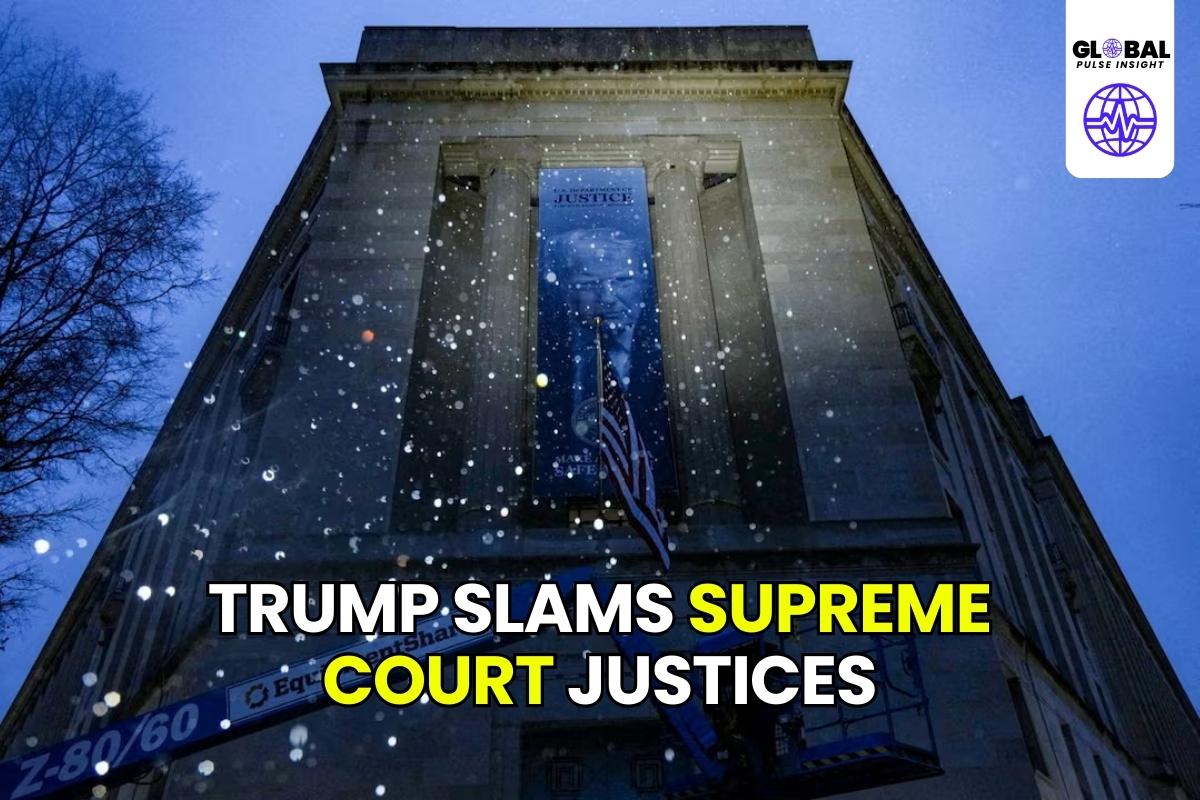
In a dramatic escalation of tensions between the executive and judicial branches, Donald Trump launched a strong and highly personal attack on the Supreme Court of the United States after it struck down his administration’s sweeping tariff policy.
The ruling, delivered on Friday, marked one of the most significant legal defeats of Trump’s current term. The court concluded that the president does not hold unlimited authority to impose broad tariffs on foreign countries without clear legal backing.
A Sharp Reaction from the White House
Speaking at a press conference shortly after the decision, Trump expressed deep frustration, calling the outcome “deeply disappointing.” However, his response went far beyond policy disagreement.
He openly criticized the six justices who formed the majority opinion, accusing them of lacking courage and failing to act in the country’s best interest. His remarks quickly turned into a broader critique of the judiciary, an approach that stood out even for a leader known for blunt and direct communication.
For nearly an hour, Trump continued to defend his tariff strategy, insisting it was essential for protecting national economic interests. At the same time, he made it clear that he would explore alternative ways to continue implementing trade restrictions despite the ruling.
Court Decision Limits Presidential Power
At the heart of the case was a fundamental constitutional question: how much authority does a president have over trade policy?
The court ruled that sweeping tariffs cannot be imposed solely at the president’s discretion. Instead, such actions must align with existing laws and require proper legal justification.
This decision reinforces the system of checks and balances, ensuring that no single branch of government can exercise unchecked power over major economic decisions.
Criticism Across Party Lines
One notable aspect of Trump’s reaction was that he did not limit his criticism to justices appointed by opposing political parties.
The six justices who ruled against his tariff policy represented both liberal and conservative wings of the court. This included individuals appointed by Democratic as well as Republican presidents-some even nominated by Trump himself during his earlier term.
Despite this, Trump directed his frustration at all members of the majority, signaling that his disagreement was rooted more in the outcome than in partisan alignment.
Controversial Claims and Personal Remarks
Trump’s comments became increasingly pointed as he questioned the motivations behind the ruling. He suggested, without providing evidence, that external influences may have played a role in shaping the court’s decision.
Additionally, he made unusually personal remarks regarding some justices, even referencing their
families-something rarely seen in public statements from a sitting president.
Such comments have sparked debate among political observers about the tone and boundaries of executive criticism toward the judiciary.
Praise for Dissenting Justices
While Trump strongly criticized the majority, he offered clear support for the three justices who dissented from the ruling.
He specifically highlighted their stance as aligned with national interests and praised their legal reasoning. One dissenting opinion warned that overturning the tariffs could lead to significant financial complications, including the potential need to refund billions in collected revenue.
This division within the court underscores the complexity of the issue and the broader debate surrounding presidential authority in economic matters.
Expert Reactions: A Divided Response
Legal and trade experts have offered mixed reactions to both the ruling and Trump’s response.
Some analysts view the court’s decision as a necessary reinforcement of constitutional limits. They argue that it upholds the principle that major economic actions must follow established legal processes.
Others acknowledge the political and economic stakes involved, noting that trade policy is often a critical tool for governments navigating global competition.
However, several experts expressed concern about the tone of Trump’s remarks, suggesting that direct personal attacks on the judiciary could have long-term implications for institutional trust.
What This Means for U.S. Trade Policy
The ruling is expected to have a lasting impact on how future administrations approach tariffs and international trade.
Key Implications:
- Presidents may face stricter legal boundaries when introducing tariffs
- Trade policies could require greater coordination with lawmakers
- Businesses may experience uncertainty as policies are reassessed
At the same time, Trump’s pledge to find alternative methods suggests that the debate over tariffs is far from over.
A Broader Political Moment
This episode reflects a larger dynamic in modern governance-where legal decisions, political strategy, and public messaging intersect.
Trump’s reaction highlights the tension that can arise when major policy initiatives are challenged by the courts. It also raises important questions about how leaders respond to institutional checks on their authority.
For observers, this is not just about tariffs-it’s about the evolving relationship between different branches of government.
FAQs
1. Why did Trump criticize the Supreme Court tariffs ruling?
The why Trump criticized Supreme Court tariffs ruling question centers on his belief that the decision limits presidential authority and weakens his trade strategy.
2. What is the Supreme Court tariffs ruling about?
The US Supreme Court tariffs decision explained shows that the president cannot impose broad tariffs without proper legal authorization.
3. How does this ruling impact U.S. politics?
The impact of Supreme Court tariffs ruling on US politics includes increased tension between branches of government and changes in future policy-making.
4. What is the Trump vs Supreme Court conflict?
The Trump vs Supreme Court conflict refers to ongoing disagreements between Trump and the judiciary, now intensified by this ruling.
5. What happens next after this tariffs ruling?
Following the Trump reaction to court ruling on trade tariffs, new legal strategies and political debates are expected to shape the future of U.S. trade policy.
Conclusion:
The Trump Slams Supreme Court Justices Over Tariffs Ruling story is more than just a headline—it’s a defining moment in modern U.S. politics.
The Trump reaction to court ruling on trade tariffs highlights the ongoing struggle between executive authority and judicial oversight. Whether you agree with the ruling or not, it clearly shows how crucial the balance of power is in shaping national policies.
As this situation continues to evolve, staying informed is essential. For more in-depth international news and expert analysis, visit https://globalpulseinsight.com/ and stay ahead of the latest global developments.