
Introduction
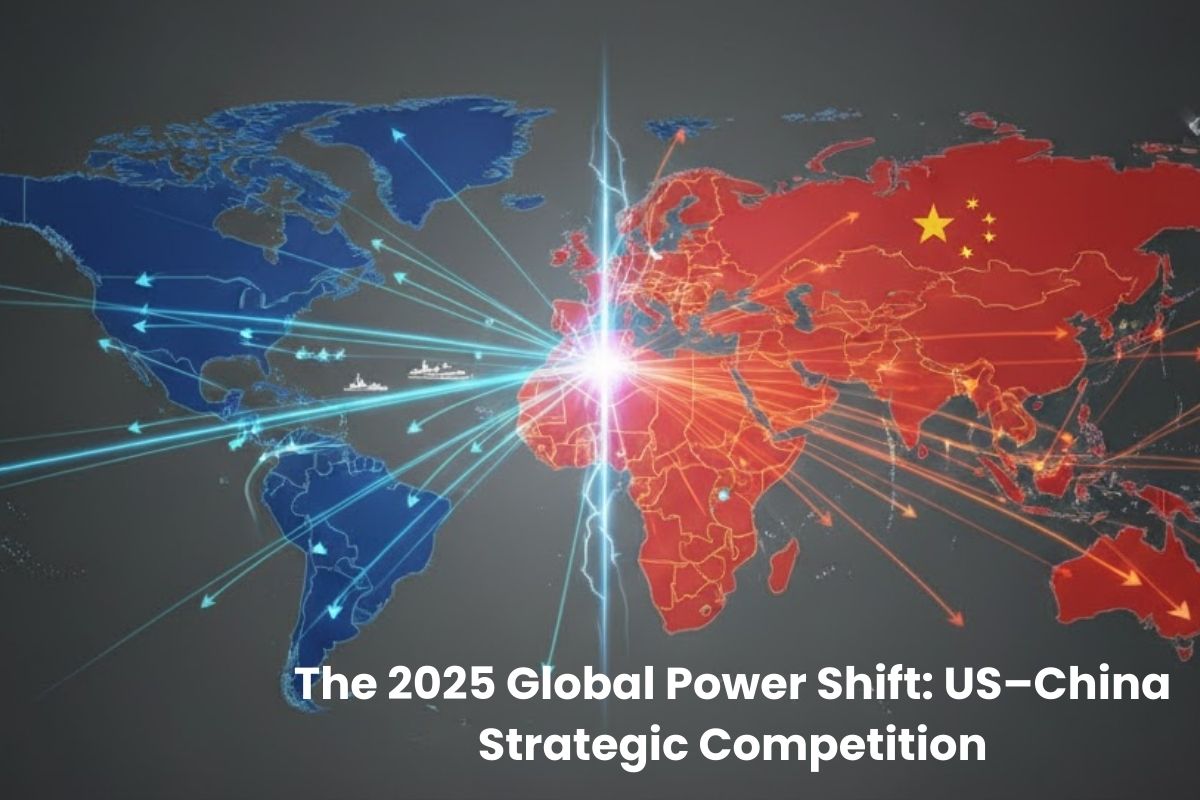
The year 2026 marks a turning point in world politics. For more than seven decades, the United States dominated the global order—militarily, economically, and diplomatically. But today, the world is witnessing a remarkable transformation. A global power shift is underway, driven primarily by the US–China strategic competition that has become the defining geopolitical conflict of the 21st century.
This rivalry is no longer just about trade or military might; it now spans technology, influence, regional alliances, and the future of the global system itself. Countries across Asia, Europe, Africa, and the Middle East are adjusting their strategies as Washington and Beijing compete for partners and strategic leverage. In 2026, this competition has intensified, with both nations reshaping their foreign policies, boosting defense capabilities, and expanding influence across key regions.
The consequences of this shift are profound. Nations that once relied heavily on the United States are now diversifying their partnerships, while China’s rapid economic growth and ambitious global programs—such as the Belt and Road Initiative—have positioned it as a central actor in reshaping global affairs. The world is transitioning from a unipolar order toward a more multipolar one, where US dominance is still powerful but contested.
This blog explores the causes, strategies, tensions, and future implications of the US–China power rivalry, breaking down complex geopolitical dynamics into clear, accessible analysis.
Understanding the Global Power Shift in 2026
The concept of a global power shift refers to changes in the balance of political, economic, and military power among the world’s leading nations. In 2026, this shift is primarily driven by China’s rise as a challenger to the United States, the long-standing global superpower.
The Decline of Unipolarity
After the Cold War, the US stood alone as the world’s dominant power. But over the last decade, several factors have contributed to the erosion of this unipolar moment:
- The rise of China as the world’s second-largest economy
- Russia’s return as a disruptive military actor
- Europe’s increasing strategic autonomy
- Regional powers like India, Turkey, and Iran becoming more assertive
- Global economic diversification
China’s rapid growth, technological capabilities, and military modernization have pushed the global system toward multipolarity—where power is distributed more widely among multiple nations.
US–China Strategic Competition in 2026
At the heart of the global shift is an intense rivalry between Washington and Beijing. Their competition spans multiple domains.
1. Economic Competition & The Push for Decoupling
Economics forms the foundation of the rivalry.
China’s Economic Rise
China’s economic model—state-led development, large-scale manufacturing, and global investment—has helped it close the gap with the US. In 2026, China continues:
- Expanding its share in global trade
- Leading in electric vehicles (EVs)
- Dominating rare earth mineral supply chains
- Investing heavily in Africa, Southeast Asia, and Latin America
US–China Economic Decoupling
For years, both countries relied on each other economically, but now they are gradually “decoupling” in critical sectors like:
- Semiconductors
- Telecommunications
- AI technology
- Defense-related supply chains
This US–China economic decoupling 2026 trend aims to reduce dependency and protect national security.
Global Impact
The world economy is being reshaped as nations are forced to choose between American and Chinese technology systems.
2. The Military Rivalry and Power Projection
The most visible form of competition lies in military strength.
China’s Military Expansion 2026
China has expanded:
- Naval forces in the South China Sea
- Missile capabilities
- Artificial islands equipped with military bases
- Blue-water navy deployments into the Indian Ocean
China aims to challenge US naval dominance by 2035.
US Indo-Pacific Strategy Updates
In response, the United States has strengthened partnerships with:
- Japan
- South Korea
- Australia
- The Philippines
- India through the Quad
The Indo-Pacific is now the main battlefield for influence.
US–China Naval Competition in the South China Sea
This region is critical for global trade. The rivalry increases chances of miscalculation and conflict.
3. Taiwan: The Flashpoint of Global Tensions
No issue is more sensitive or dangerous than Taiwan.
China Taiwan Pressure 2026
China continues:
- Airspace incursions
- Naval drills around the island
- Political pressure
- Cyberattacks
Beijing sees Taiwan as a core national interest.
US Security Commitment
The US increases arms sales and military training to Taiwan, while maintaining its policy of “strategic ambiguity.” If a conflict erupts over Taiwan, it would reshape global geopolitics entirely.
4. The Technology War: AI, Chips & Cybersecurity
The US–China tech war has become a defining battleground.
The Race for AI Leadership
Both nations invest heavily in AI for:
- Military use
- Surveillance systems
- Industry automation
- Big data intelligence
Semiconductor Competition
The US restricts China’s access to advanced chips using export controls. China responds by boosting domestic chip production.
Cyber Warfare
State-sponsored cyberattacks from both sides target:
- Government agencies
- Critical infrastructure
- Private companies
5. Strategic Influence Across Regions
The US and China compete for influence across the globe.
Southeast Asia
China uses:
- Infrastructure loans
- Trade agreements
- Soft power diplomacy
The US counters with military partnerships and security guarantees.
Africa
China dominates African markets through:
- Mining
- Railways
- Industrial zones
The US focuses on governance, transparency, and development aid.
Middle East
China strengthens ties with Gulf states by investing in energy and technology, while the US remains the primary security provider.
6. Diplomacy & Soft Power Strategies
China’s Soft Power Strategy 2026
China uses:
- Media influence
- Confucius Institutes
- Cultural exchanges
- Belt and Road diplomacy
to build global goodwill.
US Diplomacy Changes
The US modernizes its diplomacy by:
- Reinforcing alliances
- Promoting democratic values
- Expanding economic partnerships
However, both nations face resistance from countries unwilling to pick sides.
7. Geopolitical Consequences of US–China Conflict
The rivalry has far-reaching consequences:
Impact on Global Politics
- Nations are pressured to align with one side
- Regional organizations split internally
- Smaller states use the rivalry to gain concessions
- Multipolarity becomes more complex and unpredictable
Economic Effects
- Global supply chains reorganize
- Investment flows shift
- Technology ecosystems fragment into two blocs
Security Risks
- Higher probability of military accidents
- Intensification of arms races
- Increased proxy conflicts
US–China Relations After 2026: Future Outlook
Looking ahead, three possible scenarios shape the future.
Scenario 1: Competitive Coexistence
Both nations continue competing but avoid war. This is the most likely scenario.
Scenario 2: Controlled Confrontation
Rivalry becomes more aggressive, especially in the South China Sea and Taiwan.
Scenario 3: Diplomatic Reset
A shift in leadership or economic pressures could lead to limited cooperation-though this is the least likely.
Conclusion
The 2026 global power shift reflects a world in transition. As the US–China strategic competition intensifies, the future of global politics, economics, and security is being reshaped. The rivalry is not just about dominance it is about who will define the rules of the 21st century.
From military tension and technology conflicts to diplomatic maneuvering and trade realignments, both nations are shaping a new world order. The challenge for the international community is to navigate this rivalry without triggering instability or conflict. Whether the world moves toward cooperation or confrontation will depend on how wisely both powers manage their ambitions in the years ahead.




3 Responses