
Introduction
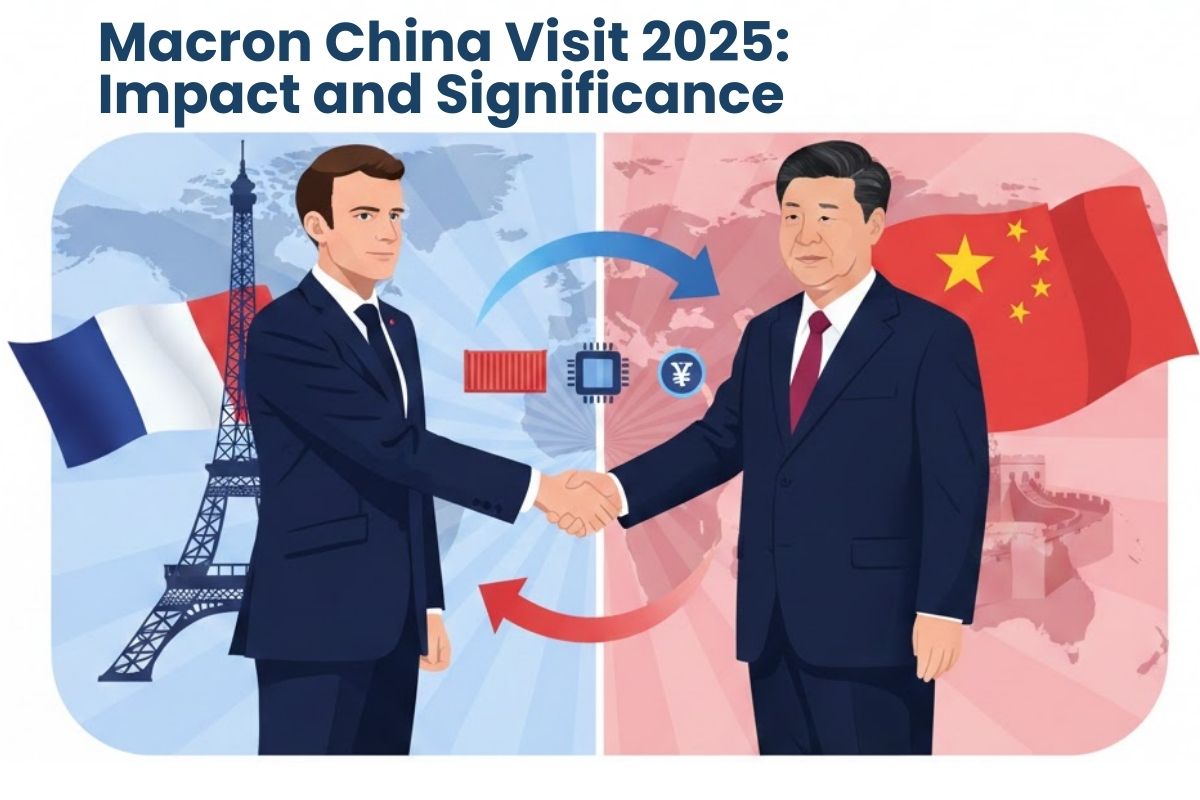
The December 2026 state visit of Emmanuel Macron to China marks a critical juncture in international diplomacy. At a time when global geopolitics are being reshaped by economic shifts, military tensions, and competition for technological supremacy, this visit carries weight far beyond bilateral ceremony. For France – and by extension the European Union (EU) – it is an opportunity to redefine relations with China in a way that balances cooperation and strategic autonomy. For China, deeper engagement with a leading European power remains a keystone of its global outreach.
The visit reflects mutual recognition of historic ties. France was among the first major Western powers to establish formal diplomatic relations with New China, and over decades the two nations have built a “comprehensive strategic partnership.” People’s Daily Online+2gb.china-embassy.gov.cn+2 This 2026 visit, announced at the invitation of Chinese President Xi Jinping, is the fourth state visit by Macron to China and reciprocates Xi’s trip to France last year – a milestone marking 60 years of diplomatic relations. People’s Daily Online+1
Amid a deteriorating global environment – with ongoing conflicts, supply-chain pressures, and intensifying East-West rivalry – Macron’s China visit takes on heightened importance. The discussions are expected to cover not just trade and economics, but also security, technology, global governance, and international crises such as Ukraine. The outcome could shape the future trajectory of Europe-China ties, and influence broader global alignments.
In this post, we analyze the causes behind this visit, its immediate and long-term implications, and what it may mean for Europe, China, and global geopolitics.
Background – Why 2026 and Why Now
Evolving Global Landscape and Europe’s Dilemma
In recent years, Europe has found itself balancing between economic reliance on China and political-security pressures tied to US-China rivalry. The EU has increasingly voiced concerns over trade imbalances, technological dependencies, and China’s rising global assertiveness. France, as one of Europe’s leading powers, has in particular stressed the need for strategic autonomy – resisting becoming overly reliant on either China or the US. The Guardian+1
Meanwhile, global conflicts – from the war in Ukraine to tensions in Asia – have underscored how interlinked economic, security and geopolitical questions have become. Europe seeks to maintain its influence, uphold multilateral norms, and avoid being drawn into binaries. For China, engaging with a major European nation sends a signal that its global ambitions extend well beyond Asia-Pacific.
Thus, 2026 presents a moment where both sides see value in renewing dialogue: Europe to recalibrate its dependencies, and China to consolidate its role as a global power with European links.
Strengthening Sino-French Foundations
The foundation for Macron’s visit rests on decades of diplomatic engagement between France and China. Over the years, the two sides have pursued cooperation across trade, education, technology, and multilateral diplomacy. gb.china-embassy.gov.cn+2Chinese Foreign Ministry+2
Earlier in 2026, the two countries held a strategic dialogue that reinforced their commitment to cooperation in multiple domains. Chinese Foreign Ministry+1 That alignment sets the stage for the December visit – not as an isolated event, but as part of a broader trend of deepening ties.
Key Focus Areas of the 2026 Visit
Bilateral Cooperation – Trade, Investment, and Technology
One of the central goals of Macron’s visit is to bolster France-China economic cooperation under “new circumstances.” Anadolu Ajansı+1 Given the scale of China’s economy and France’s industrial and technological capacities, mutual cooperation can yield benefits in several areas: trade, green energy, aerospace, innovation, and services. gb.china-embassy.gov.cn+2PR Newswire+2
France’s openness to Chinese investment, along with China’s willingness to expand market access in sectors such as telecom, medical services, and manufacturing, lays the foundation for renewed bilateral economic engagement. gb.china-embassy.gov.cn+1
Diplomatic Coordination & Global Issues
Beyond bilateral economics, the visit aims to ensure alignment or at least dialogue on global challenges. During the visit, talks will cover regional hotspot issues and major international concerns. People’s Daily Online+2A News+2 In a world increasingly defined by interconnected crises – climate change, energy insecurity, conflicts, and economic instability – cooperation between France and China could contribute to multilateral solutions.
Given that both nations are permanent members of the United Nations Security Council, their cooperation may influence global governance, crisis resolution, and balance-of-power dynamics. Embassy of China in Estonia+1
Rebalancing Europe-China Relations – Strategic Autonomy & De-Risking
A central theme of Macron’s approach is to reimagine Europe’s relationship with China – not as a dependency, but as a partnership based on mutual respect and strategic autonomy. According to remarks from sources close to the French presidency, Macron aims to formalize a Sino-European framework based on mutual interests, rather than as a function of US-China rivalry. South China Morning Post+1
He reportedly intends to press for trade rebalancing, and to encourage China toward greater domestic consumption and technology sharing, which could help reduce Europe’s economic vulnerabilities. Reuters+1
This rebalancing effort may also involve asking Beijing to moderate its support for countries seen as adversaries of EU interests – for example, to reduce support for Russia’s war effort in Ukraine. euronews+1
Potential Impact and Implications
Short-Term Effects – Diplomacy, Markets, and Signals
In the immediate aftermath of the visit:
- Diplomatic cooling of tensions: The visit signals Europe’s intention to maintain open communication with China despite geopolitical storms. It serves as a balancing act, showing that EU nations like France seek autonomy.
- Market optimism for businesses: French and European companies may find improved access or new opportunities in Chinese markets – especially in sectors Beijing is opening up (services, high-tech, green energy).
- Renewed global diplomacy: Cooperation between China and a major European power may influence global debates over Ukraine, China-US tensions, climate change, trade rules, and global governance.
Medium-to-Long-Term Effects – Strategic Realignment
Over the coming years, the visit could contribute to:
- A more structured Europe–China partnership: If both sides deliver on agreements, trade and investment flows could increase, and cooperation in emerging fields (AI, green energy, aerospace, biotech) could deepen. This may shift some global supply-chain dependencies.
- Europe’s strategic autonomy: With frameworks for cooperation that do not necessarily follow US or Chinese agendas, Europe may assert itself as a “third pole” – independent but engaged.
- Global multipolar balance: As China and France coordinate on global issues, the influence of traditional power blocs (like US-led alliances) may be challenged. This could reshape global diplomacy, trade, and security dynamics.
Risks & Challenges – Dependence, Diverging Interests, External Pressure
However, the renewed partnership comes with risks:
- Over-reliance: There is a danger that economic engagement evolves into dependence, especially if European firms become too reliant on Chinese markets, supply chains, or raw materials (e.g. rare earths).
- Diverging interests: On issues such as human rights, security (e.g. Taiwan, South China Sea), or alignment with the US/NATO, China and Europe may still diverge – limiting the depth of cooperation.
- External pushback: Other global powers, particularly the US, may view deeper Europe-China engagement with suspicion, and impose diplomatic or economic countermeasures.
Geopolitical Analysis -What This Means for Europe, China, and the World
Europe’s Balancing Act – Autonomy vs. Alignment
With this visit, Europe – represented by France – demonstrates an intent to navigate between superpower rivalry without being forced to choose a side. Macron’s stated vision is for Europe to be “a major partner” of China, not a “variable in tensions.” South China Morning Post+1 This approach underscores a push for strategic autonomy: Europe seeks to protect its interests, influence global governance, and preserve multilateralism, rather than become overly dependent on the US or China.
If successful, this could position Europe as a credible third pole in a multipolar world – one that engages economically with China, but retains independence in foreign policy and security. That shift could recalibrate global alliances, trade patterns, and diplomatic coalitions.
China’s Global Strategy – Deepening Ties with Europe
For China, strengthening ties with a major European power like France helps legitimize its global ambitions, particularly at a time when tensions with the US continue over Taiwan, technology, trade, and influence. The visit strengthens China’s access to European markets and technology, and adds to its soft power.
Moreover, a framework of cooperation with Europe may help China counterbalance US-led containment efforts. By engaging with Europe on trade, investment, climate, and diplomacy, China can present itself as a constructive global actor, rather than a threat.
Implications for Global Governance, Trade, and Security
A more harmonious Europe–China relationship could usher in a new phase of global cooperation:
- Trade and investment flows may diversify, reducing over-reliance on single markets or blocs.
- Cooperation on global challenges – climate change, energy, health, governance -may get reinvigorated through joint initiatives.
- Security and diplomacy: On conflicts like Ukraine or global tensions involving superpowers, a collaborative Europe–China axis may promote multilateralism over polarisation.
At the same time, such realignment may provoke pushback from powers that view China’s rise with suspicion – potentially complicating global stability.
What to Watch – Key Questions in Coming Months
As the world watches the outcomes of Macron’s 2026 China visit, some important questions remain:
- Will the promised economic and trade agreements materialize, especially in high-tech, green energy, and services sectors?
- Can Europe maintain strategic autonomy without being drawn into bloc-based rivalry?
- How will the US and other global powers respond to deeper Europe-China cooperation? Will there be diplomatic resistance or economic counters?
- On security issues – conflicts, human rights, Taiwan – will Europe and China find compromise, or will diverging interests limit cooperation?
- Finally, will such engagements influence global governance in favor of multilateralism, or will new alliances emerge that reconfigure global blocs?
Conclusion
The 2026 visit of Emmanuel Macron to China is more than just a diplomatic ritual – it represents a pivot point in global geopolitics, with the potential to reshape Europe-China relations, realign trade and investment flows, and influence global diplomacy and security. For France and Europe, the visit offers a chance to assert strategic autonomy and engage China on pragmatic, interest-based terms. For China, it is an opportunity to deepen ties with a major European power and reinforce its role in global governance.
Yet the path forward is not without challenges: balancing dependencies, reconciling diverging interests, and navigating external pressures will demand caution, foresight, and multilateral cooperation. Ultimately, whether this visit becomes a turning point or a footnote depends on follow-through – the agreements reached, the policies adopted, and the broader global response.
As global power dynamics continue to shift, the world might well look back at December 2026 as a moment when Europe and China recalibrated their relationship – for better or worse.




2 Responses