
Introduction
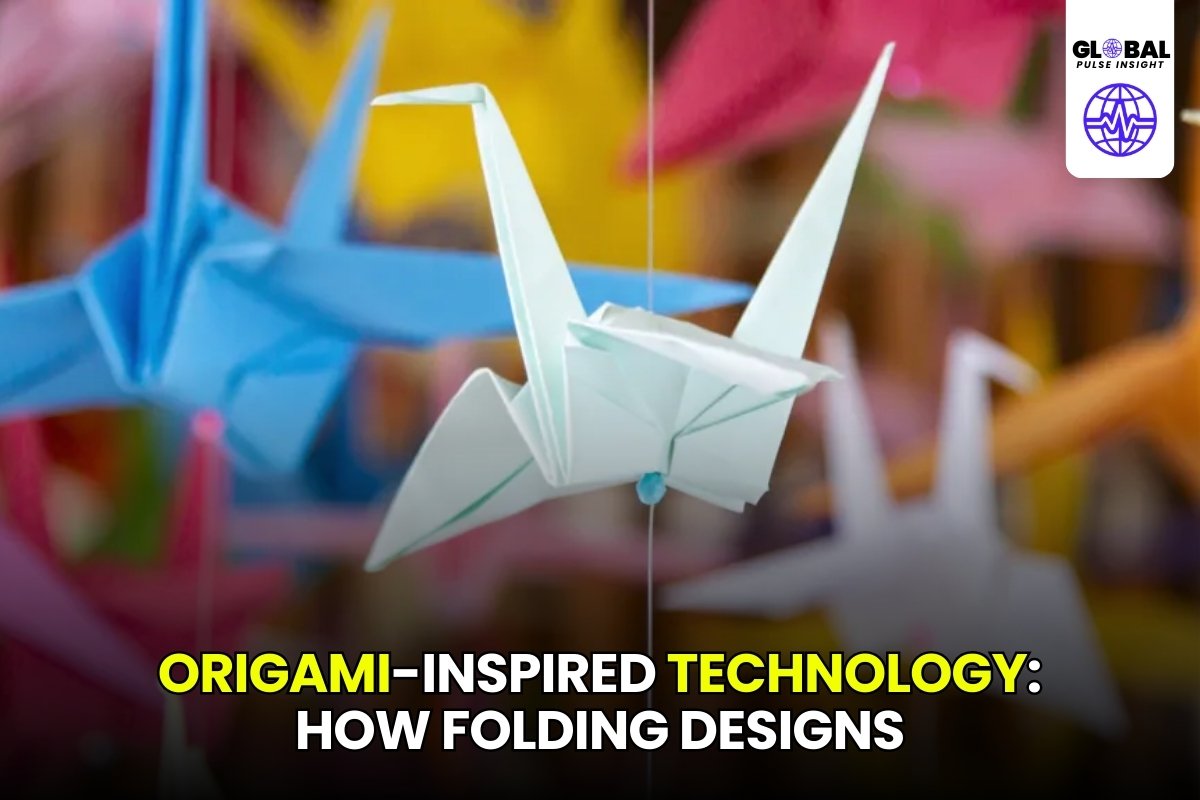
The ancient art of origami-inspired Technology, and its variation kirigami, is making waves far beyond traditional paper crafts. Today, these techniques are inspiring modern engineering solutions that range from deployable structures and foldable materials to medical devices and aerospace innovations. Researchers are discovering that the principles behind simple paper folds can be applied to solve some of the most complex challenges in science, engineering, and design.
At the forefront of this movement is Massachusetts Institute of Technology, where PhD student Akib Zaman and his team recently achieved a breakthrough. Using a flat, grid-like sheet of specially designed material, they created a small, three-dimensional chair that “popped up” when a thread was pulled-a tangible demonstration of how ancient arts can inform cutting-edge technology.
Historical Background
Origami has been practiced in Japan for centuries, traditionally as an artistic and cultural activity. Over time, scientists and engineers began to recognize the potential of folding patterns in practical applications. Kirigami, which combines folding with cutting, further expanded the range of possible designs, enabling more complex and adaptive structures.
A landmark moment in origami-inspired engineering came with the Miura fold, developed by Japanese astrophysicist Kōryō Miura. The Miura fold allows a flat surface to compactly fold and then deploy efficiently, making it ideal for applications like solar panels on satellites. In 1995, a Japanese satellite successfully used this technique to deploy solar panels in space, showcasing its practical utility. However, scaling these designs and adapting them to materials other than paper has remained a significant challenge, due to the flexibility and forgiving nature of paper compared to metals or polymers.
Key Developments
Recent research and innovation have brought origami-inspired technology from theory to real-world applications. At MIT, Zaman’s team developed a 3D-printable material divided into square, tile-like segments. By designing precise angles and cuts between these tiles, a flat sheet can fold and compress into three-dimensional forms. Their approach relies on computational software that converts a 3D design into a flat pattern, which can then be activated using a pull mechanism. The result: structures ranging from small furniture pieces to potential building components and even miniaturized medical devices capable of targeted drug delivery.
Industrial applications are also emerging. Stilfold, for instance, is leveraging origami-inspired techniques to shape sheet metal. By creating controlled creases, Stilfold strengthens metal structures without extra supports, reducing material use and production costs. The company has applied these methods to manufacture chassis for electric motorcycles and is collaborating with major automotive firms like Volvo and Scania to develop lightweight vehicle components.
In aerospace, researchers at Northeastern University have patented foldable wing structures inspired by origami. These wings can flex dynamically, mimicking bird feathers, potentially improving aerodynamic efficiency in aircraft and wind turbines. Similarly, folded cardboard designs are being explored for sustainable, protective packaging.
Regional and Global Implications
Origami-inspired technology has far-reaching implications for industries worldwide:
- Sustainable Manufacturing: By using geometry to create structural strength, folding techniques reduce material consumption, lower production costs, and minimize environmental impact-a key consideration for industries globally.
- Aerospace and Space Exploration: Compact, deployable structures like solar panels, antennas, or temporary habitats can reduce launch costs while maintaining functionality, which is critical in space missions.
- Healthcare Applications: Miniaturized, foldable devices can revolutionize drug delivery and minimally invasive procedures, improving patient outcomes and enabling more precise treatment options.
- Architecture and Disaster Response: Deployable structures can serve as emergency shelters or portable infrastructure, particularly in regions affected by natural disasters, providing rapid and effective solutions.
Analysis and Predictions
Origami-inspired engineering represents a paradigm shift in design philosophy. Traditional engineering often relies on adding materials to achieve strength. Folding-based designs, on the other hand, exploit geometry to create durable, lightweight structures efficiently. This approach challenges conventional methods and opens doors to innovation across multiple sectors.
Despite its promise, adoption faces hurdles. Scaling origami designs for large structures or adapting them to materials like metal and polymer requires precision, durability, and significant investment in research. Engineers also need to overcome reluctance to change conventional design practices.
Looking forward, several trends are likely to shape the field:
- Advanced Materials: Researchers are developing materials capable of repeated folding without structural degradation.
- Automation and Robotics: Robotic systems can create precise folds in metals and composites, enabling scalable production.
- Cross-Industry Collaboration: Partnerships between academia, startups, and established industries will accelerate commercialization, particularly in aerospace, automotive, and medical devices.
These trends suggest that origami-inspired designs could become standard practice in engineering within the next decade.
Data, Statistics, and Figures
- Studies indicate folding-based designs can reduce material usage by 20–30% while maintaining structural integrity.
- The global lightweight materials market, which can benefit from origami-inspired innovation, is projected to exceed $300 billion by 2030.
- MIT and Northeastern University publications show a growing number of patents and research projects exploring foldable and deployable structures.
- Aerospace applications, such as Miura-folded solar panels, have demonstrated measurable cost reductions and improved deployment efficiency in satellites.
These figures illustrate the practical and economic potential of origami-inspired engineering.
Practical Insights: Why This Matters
Origami-inspired technology is more than a niche academic curiosity; it is a practical tool for creating efficient, adaptable, and sustainable solutions:
- Businesses adopting these techniques can reduce production costs and material usage.
- Engineers and designers can leverage folding principles to create smarter, lighter, and more resilient products.
- Policymakers and urban planners can explore deployable structures for disaster relief, temporary housing, or innovative infrastructure.
For consumers, innovations like lighter vehicles, efficient energy systems, and flexible medical devices could significantly improve quality of life over time.
Faqs
1. What is origami-inspired engineering?
Origami-inspired engineering is the application of traditional folding techniques from origami and kirigami to modern materials and structures. Engineers use precise folds and cuts to create lightweight, adaptable, and strong designs for industries like aerospace, automotive, and medicine.
2. How is kirigami different from origami in technology?
While origami relies solely on folding paper to create shapes, kirigami incorporates both folding and cutting. This allows more complex and flexible designs, making it particularly useful for engineering applications such as deployable structures and medical devices.
3. What are the real-world applications of origami-inspired technology?
Applications include foldable solar panels for satellites, lightweight vehicle components, deployable emergency shelters, packaging inserts, and miniaturized medical devices for targeted drug delivery. Companies like Stilfold and research institutions like MIT and Northeastern University are actively developing such solutions.
4. What are the benefits of using folding techniques in engineering?
Folding-based designs improve material efficiency, reduce production costs, and create structures that are both lightweight and strong. These techniques also enable dynamic adaptability, allowing structures to change shape or function on demand.
5. What challenges does origami-inspired technology face?
Challenges include scaling designs for large structures, adapting folds to materials other than paper (like metal or polymers), and ensuring durability under repeated use. Despite these hurdles, advances in mathematical modeling and material science are helping overcome these limitations.
Conclusion
Origami and kirigami are transforming engineering and design. What once was a delicate art form is now a powerful source of inspiration, offering solutions that are lighter, stronger, and more adaptable than traditional approaches. From aerospace to automotive, medicine to architecture, the principles of folding are opening new frontiers for innovation.
While challenges remain, ongoing research and collaboration suggest that origami-inspired engineering will play an increasingly central role in shaping the technologies of the future. The art of folding, ancient yet ever-relevant, is proving that sometimes, the simplest techniques can unlock the most complex solutions.
Disclaimer:
This article provides analytical commentary based on publicly available information and does not represent official statements from any government or organization.